Portable Appliance/ Safety Testing
Content was last
updated in 06.01.17-00
Revision
History
To keep a business functional at
all times, the assets it is using must in a ready-for-deployment condition
24x7. To achieve this, they must be maintained in pristine condition by
being serviced on either a cyclic or as-and-when required basis.
In most cases, such servicing on
inventory items is usually done periodically. Therefore, from a business
and its operational perspective, knowing the tentative/ required date
of the service becomes imperative. This way, servicing can be carried
out smoothly and business' operations remain balanced and streamlined
without affecting item/ asset outage/ unavailability.
This way the required compliance
is maintained on the servicing needs of all items/assets.
And Orders can be planned since there
is a 360° visibility
on concurrent or prospective maintenance schedules of items/assets.
A new custom report has been designed,
that provides a ready reckoner about items and assets for which scheduled
services are past their due dates or are due upto 30, 60 or 90 days in
the future.
As obvious, the Next
Service Date is not a keyed-in field for the database, and it can
only be calculated for the services that
are periodic in nature.

|
The
next service date is calculated based on the following formula:
Next Service
Date = Last service completion date + Scheduled duration* for
periodic service (In Days)
*The Scheduled
duration for periodic service is a user-defined field,
specified in the Product Maintenance Group for each Item/Asset. |
This formula is cumulatively calculated
on a pro-rata basis. Simply means, 'Next Service Date' for this phase
of calculation becomes 'Last Service Completion Date' for next phase.
Similarly, there is a concept of
QC (Quality Check) which may be done impromptu either before sending an
Item/Asset in to deployment or once it is back from a client's site. At
times, depending on the scenario, it may be done at both instances.
And since QC is more of instance
based, it may be overridden manually while an item is being deployed and
the system prompts for confirmation on QC.
How this functionality works?
The
Portable Appliance/ Safety Testing functionality allows Asset’s status
to be automatically marked to QC/ Needs Service, once it satisfies the
criterion as set in service schedules added in the Maintenance Group tagged
to Asset's parent Item.
The Portable Appliance/
Safety Testing functionality is explained through a sample workflow.
Select
the Validate QC/Service on Return
checkbox (in Configuration module > Warehouse tab) to enable the
maintenance validation of Assets while scanning, based on the schedules
in their tagged maintenance group, during all warehouse operations
a shown in Figure
1.0.
By
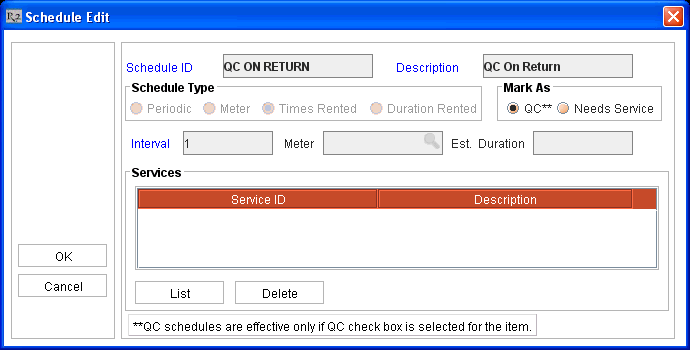
default, the system will have a built in Schedule named [QC ON RETURN]
for tagging to Maintenance Groups, as shown in Figure 1.1.
Create an Item
[SONYALPHA5] on June 01, 2021 at Site [San Francisco], and receive
few quantities of it.
Click the importable
button in Groups > Maintenance field. The Maintenance Group window
is displayed.
Click Add icon. The Schedules window is
displayed.
Enter following values
for the new Maintenance Group as:
Click List button. The Schedule List window
is displayed.
Double
click on built in Schedule named [QC ON RETURN] listed here and click
OK. This Schedule gets added
to the Maintenance Group being created and gets listed in the Schedules
window.
Click List button from Schedules window
again. The Schedule List window is displayed.
Click Add button. The Schedule Edit window
is displayed.
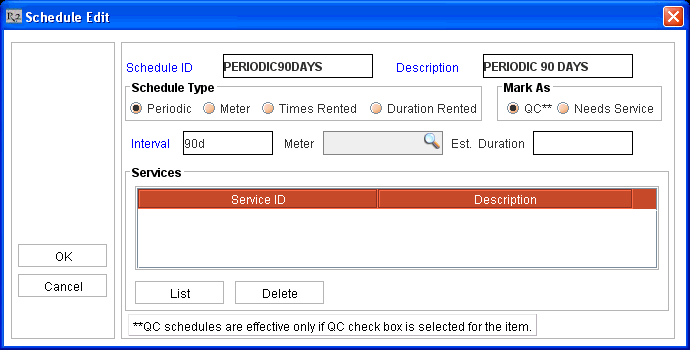
Create
a new Schedule by entering following values in the fields of the Schedule
Edit window, as shown in Figure
1.2.
Click
OK button. The Schedule gets
created and listed in Schedule List window.
Double
click on the new Schedule listed in Schedule List window and click
OK. This Schedule gets added
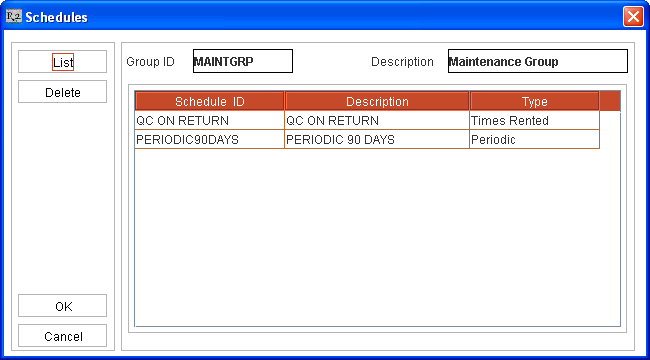
to the Maintenance Group being created and gets listed in the Schedules
window, as shown in Figure
1.3.
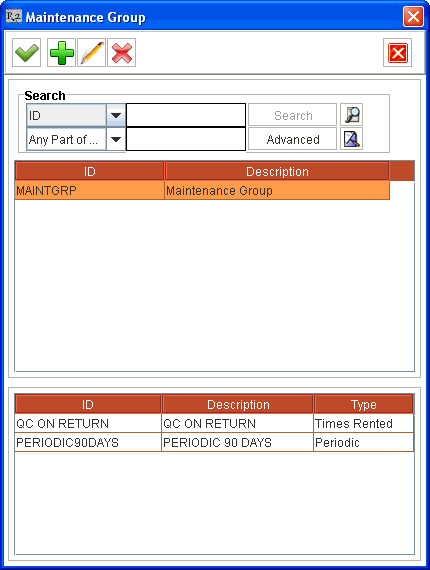
Click
OK button. The Maintenance
Group is created and is listed along with its Schedules in Maintenance
Group window, as shown in Figure
1.4.
Double-click
on the listed Maintenance Group named [MAINTGRP].
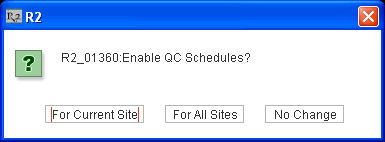
The system prompts with a message "Enable
QC Schedules?", on newly tagging a Maintenance group
having one or more Schedules with Mark
As set as QC to Item
Edit window > Groups >
Maintenance field, as shown
in Figure
1.5.
Click
For All Sites button in the
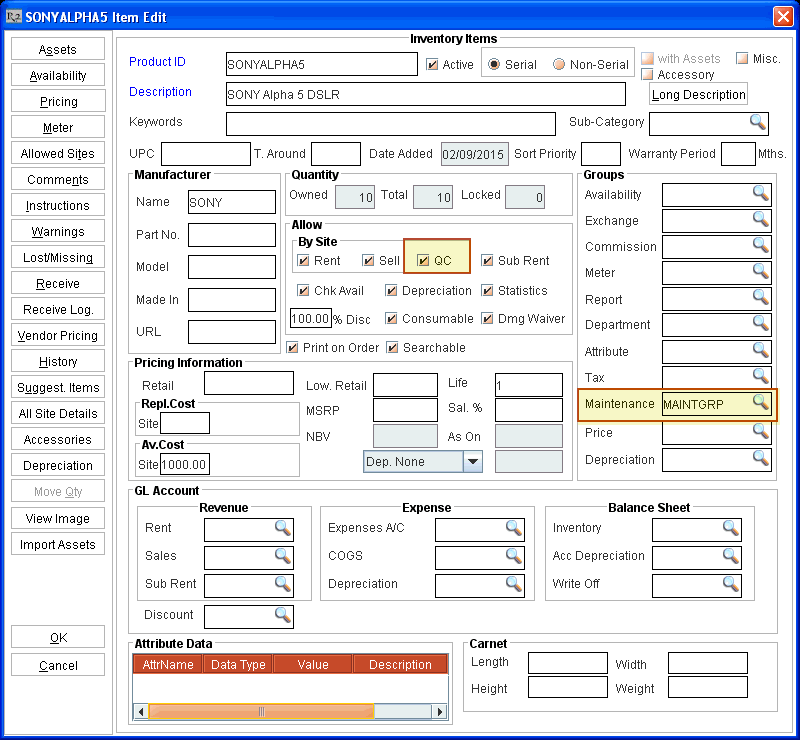
message prompt. The Maintenance Group [MAINTGRP]
gets tagged to the Item [SONYALPHA5] and the QC
check box gets selected for this Item for all Sites, as shown in Figure 1.6.
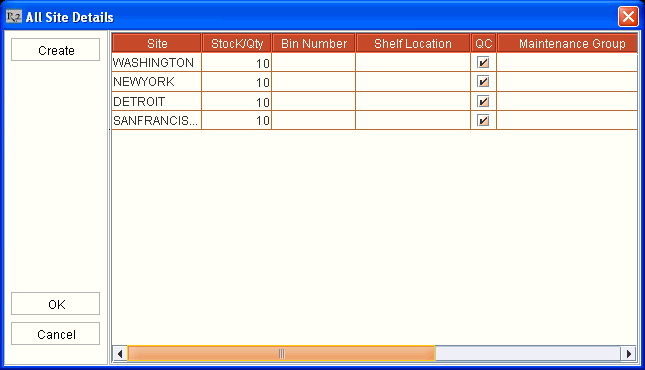
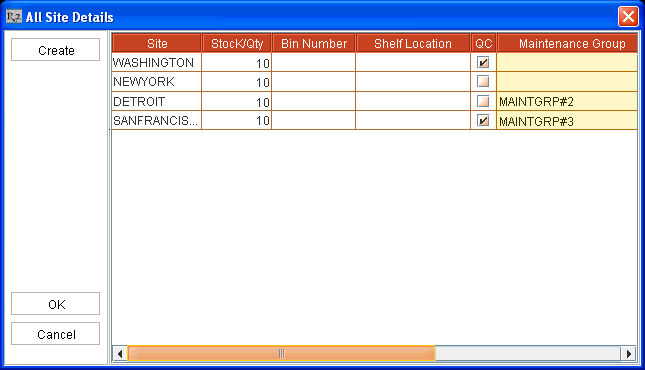
Click
All Site Details button. The
All Site Details window gets displayed listing all the Sites, as shown
in Figure
1.7. The Maintenance validation for the Item based
on condition in Schedules with Mark
As set as QC will happen
for the Item at the Sites with QC
check box selected against them.
For example:
QC check based on Schedules in tagged Maintenance Group [MAINTGRP] will
happen for Item [SONYALPHA5] at Sites [NEW YORK], [WASHINGTON], [DETROIT]
and [SAN FRANCISCO].
For more in Formation on All
Site Details dialog box set up for validating Items based on tagged Maintenance
Groups, click here.
Schedule
a Windows Task Scheduler to
schedule the periodic checking and marking of Assets’ Status to QC or Needs
Service, on a day-to-day basis.
This scheduler is required to be run on a periodic
basis to mark Assets, as QC/Needs Service, which satisfies service
conditions set in tagged Maintenance Group’s Schedules which are based
on Schedule Type as Periodic/Meter/Duration
Rented/Times
Rented.
For more in Formation on Setting
up a Windows Task Scheduler, click here.
The Assets
of the Item [SONYALPHA5] gets their Status set to QC when the windows
task scheduler runs on August 30,
2014. This is because the Item has completed 90
days without servicing. This satisfies the service condition
as set in the tagged Maintenance Group’s Schedule named [PERIODIC90DAYS].
Now,
try to ship the Assets of the Item [SONYALPHA5] whose Status set to
QC, on orders.
System will not allow shipping them as the Assets are in QC.
And this will be allowed only after bringing back the Assets’ status
from QC to IN.
Service
the Assets of Item [SONYALPHA5] on September
01, 2014 by creating Service
Tickets or by using Quick
Service feature from Service
module.
Create
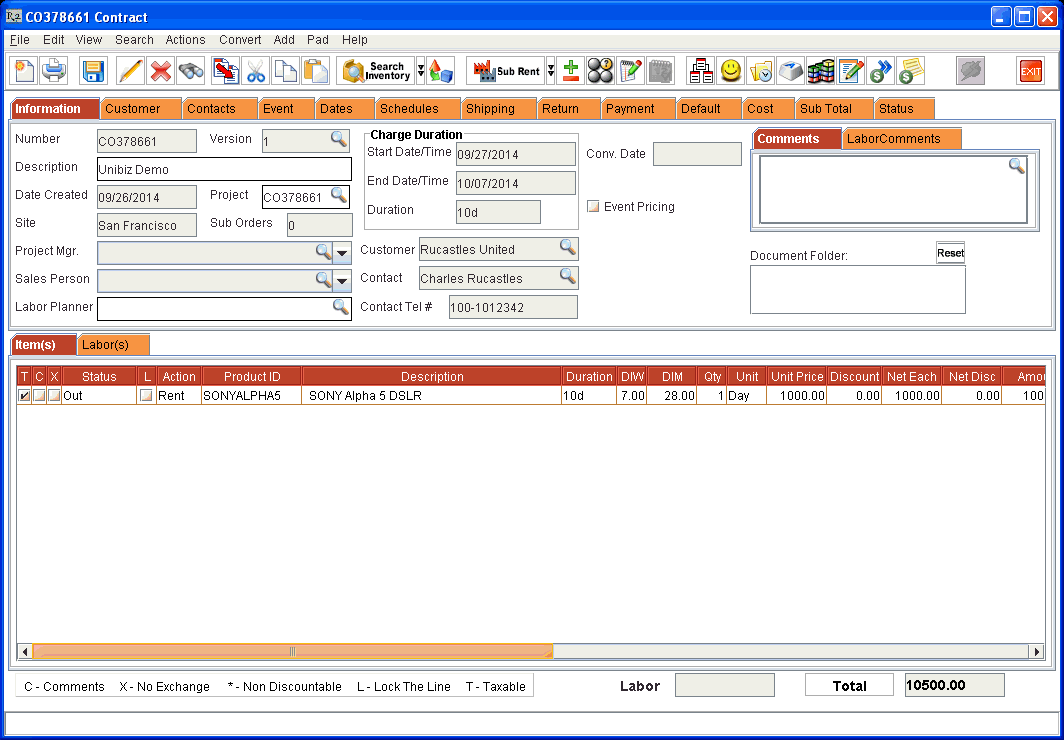
a Rental Reservation Order [CO378661] at Site [San
Francisco] on September 26,
2014.
Add
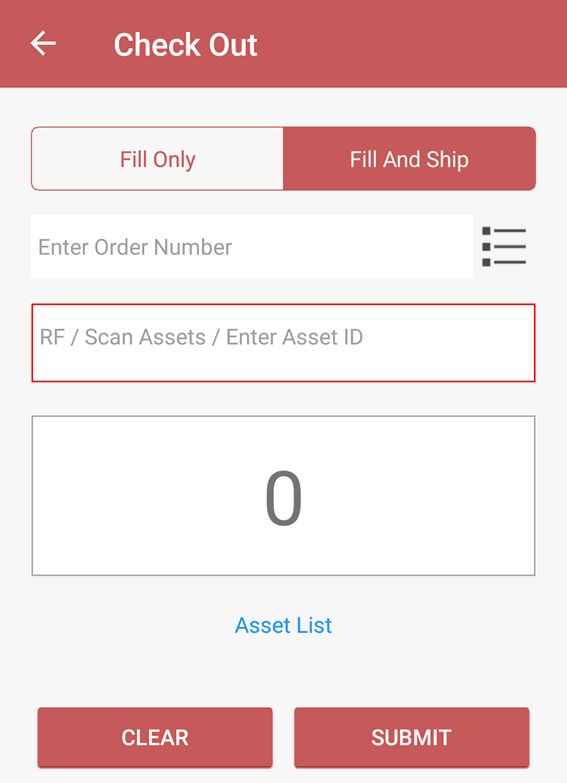
the item [SONYALPHA5] to Order [CO378661], fill and ship the Asset
[SONYALPHA#1], as shown in Figure
1.8.
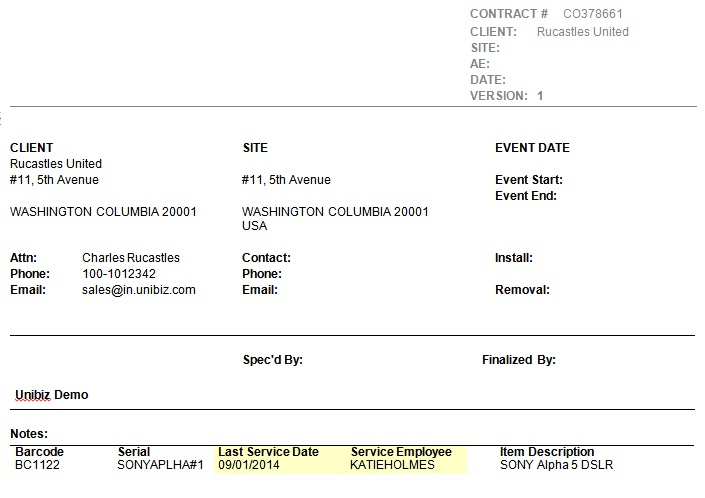
Generate
the Equipment Delivery Receipt
(EDR) print using [153800UI]
for the Order [CO378661]. The EDR print gets generated, as shown in
Figure
1.9.
CID 67
- Prints the Last Service Date for the Asset.
CID 68
- Prints the Employee ID of the Employee who performed the Last
Service.
The
Last Service details get printed in the EDR print for an Asset
if it is serviced by creating a Service Ticket or by performing
Quick Service.
Access
'Return Order' window of Order [CO378661] on October
07, 2014, and return the Asset [SONYALPHA#1].
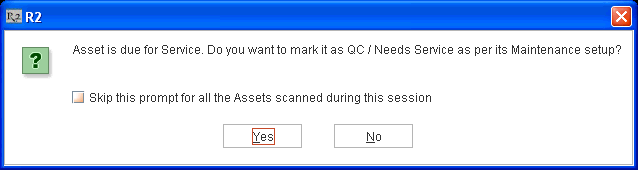
The Asset received is due for service based on the tagged Maintenance
group’s built in Schedule [QC ON RETURN] tagged to Asset’s parent
Item with Times Rented interval as 1
and QC is selected for the
Item [SONYALPHA5] and the Site [San Francisco] - the system displays
the prompt message ”Asset is
due for Service. Do you want to mark it as QC / Needs Service as per
its Maintenance setup?” with Yes
and No options, as shown in
Figure
1.10.
-
No - If No
is selected, the Asset will not be marked as QC
or Needs Service.
If
the Skip this prompt for all
the Assets scanned during this session check box is selected
- On
scanning more Assets in the same session(i.e. before exiting from the
window from where scanning of Assets is currently performed -
for example, system won't prompt message on scanning further assets
from Return Order window if this check box is selected once, till
the user exits from Return Order window) ,
the system will not display the prompt message. However, it will
mark the Assets that are due for Service as QC
/ Needs Service, if Yes was selected and but will
not be marked as QC or
Needs Service, if No was selected.
If the user
chooses to not perform the servicing of an Asset when the system prompts
based on a currently satisfying service schedule by clicking No button
then, the system starts considering the interval for the schedule from
that point onwards.
See example
and Notes
Figure 1.11:
Prompt Message Displayed for Asset that is due for Service on return
Select
the Skip prompt for all Assets due
for Service scanned during this session check box in the prompt
message and click OK button.
The system marks the Asset [SONYALPHA#1] as QC
(as per Mark as > QC option
selected in the built in Schedule
dialog box for the Maintenance group
tagged to the Asset’s parent Item).
The
system sets Asset Status as
QC for the Asset returned
on the Order which satisfies the service condition set in the tagged
Maintenance Groups with built in Schedule.
The
Assets [SONYALPHA#1] Status
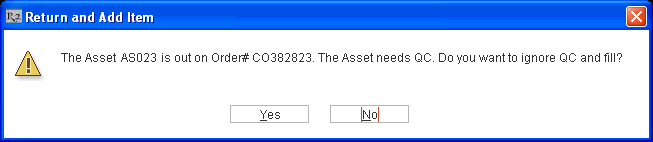
is set to QC. Assets with
status set as QC can be
filled / shipped on another Order only after servicing them. However,
the Asset with status set as QC
gets filled/shipped in Orders if Force
Order Fill check box is selected in Configuration
module > Warehouse
tab.
Assets with Status
as QC can be serviced by creating a Service Ticket or by Quick
Service feature from
Service module.
Assets
with Service Status as
Needs Service can be serviced
by creating a Service Ticket
for them.
 |
The Assets with Service Status
as Needs
Service can still be filled
/ shipped on other Orders without servicing them.
However,
once Service Ticket is
created, it cannot be filled / shipped. |
Service
the Asset [SONYALPHA#1] of Item [SONYALPHA5] by creating a Service
Ticket or by using Quick Service
feature from Service module.
Additional Information
The
Portable Appliance/Safety Testing functionality is applicable only
for Serial Item's Assets and is not applicable for Non-Serial Items.
While
scanning, generating Needs Service, or running Windows Task Scheduler,
all the Assets which satisfy service conditions set in their tagged
Maintenance Groups’ Schedule based on Schedule
Type as Periodic/Meter/Duration
Rented/Times
Rented are considered.
The
Validate QC/Service on Return
check box (in Configuration
module > Warehouse tab)
has to be selected for the Maintenance validation of Assets while
scanning, based on the schedules in their tagged Maintenance Group,
during all Warehouse operations.
The system
prompts the user with a message on satisfying the service condition
of Schedules with Mark As
- QC only if the QC
check box is set as selected in the Item
Edit window and in All Site
Details dialog box for the Site for the Asset’s parent Item.
However
even without the QC check
box selected, the system will prompt the user with a message on satisfying
the service condition of Schedules with Mark
As - Needs Service
and sets the Asset's Service Status to Needs
Service while returning, if due for Service, based on the Maintenance Group tagged to the
Item for the Site.
The
QC check box will be in cleared
state, by default, on creating a new Item.
On
trying to manually select the QC
check box in the Item edit window of an Item, the system prompts "Do you want to change in all sites?”
with Yes and No
options.
Selecting
Yes - Will set the QC
check box as selected for all sites.
Selecting
No - Will set the QC
check box as selected only for the current site and remains unmodified
in all the other sites.
Maintenance
validation for an asset while scanning an In-Transfer asset also above
mentioned point based on Owner Site
and Current Site is applicable
and will be marked as QC/Needs Service accordingly.
The
system will not allow the user to create Quick
Service Ticket for an Asset which is already having a open
Service Ticket. Instead it displays a message prompt as "Open Service Ticket exists for this
Asset. Please complete it and proceed." with OK Button.
The
system automatically creates a Service Ticket on performing Quick Service of an Asset.
The
details of Services performed for an Asset can be viewed from the
Asset Service History window
(accessed from Asset edit window > Service
button) of the Asset.
The details
of any Service which is chosen by user as not to be performed for
this Asset is also displayed here with Status
as QC/Service Skipped. When
the user chooses to not perform a service, a closed Service Ticket
is automatically created by the system for the satisfying schedules.
Additional details of this record (Service
Ticket ID, and satisfied Schedule
IDs) can be viewed by selecting this entry and clicking Comments icon and viewing its Comments.
The details
of Quick Service get entered
with Status as Quick
Service. Additional details (Service
Ticket ID, and satisfied Schedule
IDs) can be viewed by selecting this entry and clicking Comments icon and viewing its Comments.
Any
Asset when marked as Lost/Missing while returning it on an
Order will be set with status as Lost
/ Missing, but won’t have
any effect on Asset’s Service Status
even if it satisfies the criterion set in tagged Maintenance Group.
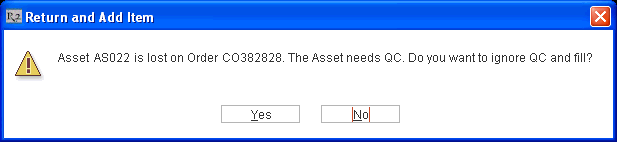
However, while returning the Lost / Missing Assets, it will prompt
for marking the assets as QC/Needs Service based on the satisfying
Maintenance Schedules.
When
an Out Asset is marked as
Damaged on Order:
With Return to Inventory and Create
Service Ticket options selected, system will create Service
Ticket for the selected Asset with Damaged
flag selected.
However,
if Return to Inventory is
selected and Create Service Ticket
is not selected, system will prompt to mark the Asset as QC/Needs Service if it satisfies any
Service Schedule at the time. But if no satisfying Service Schedule
is found, it sets it as Damaged
with Service Status as Needs Service.
If Return to Inventory is not selected,
it will not prompt to mark the asset to QC/Needs Service, rather it sets the
Service Status as Needs
Service and marks it as Damaged.
On
returning Assets by Batch Return
from the Warehouse module
also, the prompt message ”Asset
is due for Service and will be marked as QC/Needs Service based on
its Maintenance Group” will be displayed if the Asset is
due for service based on the Schedule added to the Maintenance Group
tagged to the Asset’s parent Item and same would be marked as QC/Needs
Service as per Maintenance
Group.
A
windows task scheduler can be used to schedule the periodic checking
and marking of Assets’ Status to QC or Needs Service.
The
Asset Status will be set as
QC, if the satisfying criterion
in the Maintenance Group has Mark
As set to QC instead
of marking the Service Status
as Needs Service. The check
for Schedules with Mark As
set as QC will be performed
only if the QC check box is
selected for the Item for the Site.
If
the satisfying criterion in the Maintenance Group has Mark
As set to Needs Service,
Asset’s Service Status will
be set to Needs Service.
While resolving
Physical Inventory Discrepancy,
if an Out Asset is adjusted
as IN, on completing the Physical Inventory, the Asset gets
returned on Order and is marked as QC/Needs Service based on the satisfying
Service Schedule at the time of completing the physical inventory.
Currently the Portable Appliance/Safety Testing
functionality (explained in this topic) is not supported for Serial
Kits and its child items.
Non-serial Kit’s
child Items get validated like normal Items based on the Maintenance
Group tagged to the respective Item, in its Item edit window.
Assets which are
already marked as QC or Sold won’t be validated to check
if they satisfy Maintenance conditions as per their tagged Maintenance
Groups.
The
following reports are supported for generating details of Assets satisfying
Maintenance criteria:
Rep_OrderAssetSchedule (Report for
the Assets expected to be Returned for the day and satisfying the
Maintenance criteria) - This is a function based report that can be
run as a custom report. This details of the Report's columns are provided
in Table 2.1.
Table 2.1 Report
Column Details
Column
Name |
Description |
RETURNDATE |
Items
with return date with this date and satisfy any maintenance schedule
as on this date. |
ASSETID |
The
ID of the Asset. |
STATUS |
Status
of Asset on the Order (OUT / OVERDUE).
|
SCHEDULEID |
The
ID of the first schedule tagged to the Asset whose service condition
is satisfied.
|
SCHEDULETYPE |
Type
of the Schedule. Possible values are:
Periodic Meter Duration
Rented Times Rented |
SCHEDULEINTERVAL |
The
Interval of the Schedule whose service condition is satisfied
for the Asset. |
SCHEDULEMARKAS |
The
Mark As option set in the Schedule whose service condition is
satisfied for the Asset. Possible values are:
|
ORDERID |
The
Order on which the Asset is currently in Out / In-transfer / Overdue. |
ORDERDESCRIPTION |
The
Description of the Order. |
ORDERSITE |
The
Site where the Order is created. |
Rep_AssetQCNeedServiceView
(Report for the Assets which are
QC / Needs Service by Order) -
The assets which are currently in QC / Needs Service will be extracted
in this report. This details of the Report's columns are provided
in Table 2.2
Table 2.2 Report
Column Details
Column
Name |
Description |
ASSETID |
The
ID of the Asset which is either marked as QC or Needs Service. |
ORDERID |
The
Order on which the Asset is last used where the Asset satisfied
its service Schedule criteria and is marked as QC/ Needs Service. |
ORDERSITEID |
The
ID of the Site where the Order is created. |
MARKEDAS |
The
Asset is marked as QC/Needs Service based on the Mark
As option set in the Schedule whose service condition is
satisfied for the Asset. Possible values are:
|
MARKEDONDATE |
The
date when the Asset is marked as QC/Needs Service. |
MARKEDBY |
The
ID of the Employee who marked the Asset as QC/Needs Service. |
Rep_MaintenanceScheduleLog
- This report provides the
list of Assets which are in Out/ Missing/ Lost/ In-Transfer/ Filled/
Repair/ QC/ Sold status, but has satisfying maintenance schedules
as per the date and time the report is run and as such could not be
serviced. The details of the Report's columns are provided in Table
2.3.
Table 2.3: Report Column Details
Column
Name |
Description |
ASSETID |
The
ID of the Asset which has satisfying maintenance schedules but
could not be marked as QC/ Needs Service raising an Exception. |
CURRENTASSETSTATUS |
The
current Status of the Asset at the time of generating this report. |
ASSETSTATUSCONFLICT |
The
Status of the Asset which resulted in the Asset being unable to
be marked as QC/Needs Service. |
SCHEDULEID |
The
ID of the first schedule tagged to the Asset whose service condition
is satisfied. |
SCHEDULETYPE |
Type
of the Schedule. Possible values are:
Periodic Meter Duration Rented Times Rented |
SCHEDULEINTERVAL |
The
Interval of the Schedule whose service condition is satisfied
for the Asset. |
MARKTYPE |
The
Mark As option set in
the Schedule whose service condition is satisfied for the Asset.
Possible values are:
|
CONTRACTID |
The
ID of the Rental Order or Transfer Order where the Asset is used
resulting in the exception. |
CONTRACTDESCRIPTION |
The
Description of the Rental Order or the Transfer Order. |
SITEID |
The
Site ID of the Rental Order's Site or Transfer Order's To Site's
ID. |
Setting
Up and Running a Windows Task Scheduler
A
Windows Task Scheduler can be
setup for the periodic checking of whether any Assets have satisfied the
service conditions from their tagged Maintenance Group, as explained below.
If one or more Assets satisfy the service criteria then:
The Asset Status will be set as QC,
if the satisfying Schedule in the tagged Maintenance Group has Mark As set to QC
instead of marking the Service Status
as Needs Service and also
Damaged flag will be left
unmodified. The check for Schedules with Mark
As set as QC will be
performed only if the QC check
box is selected for the Item for the Site.
If the satisfying
Schedule in the Maintenance Group has Mark
As set to Needs Service,
Asset’s Service Status will
be set to Needs Service.
For
detailed in Formation on how and when an Asset's Status/Service Status gets set to QC/Needs
Service, refer the Additional
information section in this topic.
Configuring
Oracle Client Installation and path in the Operating system
Setting up the
Windows Task Scheduler consists of the following steps.
Step
1 - Creating SQL file for executing the procedure named PatAutomation.sql
- Details
Create a ASCII
file with extension.sql (For example PatAutomation.sql).
Enter
the below command lines and save the file.
exec generateneedservice ('<UserName>',<date
for which this sql procedure should be run>);
exit;
For example:
To
connect with Username = MANTRA and for current
system date, setup the command in the ASCII file as:
exec generateneedservice ('MANTRA', sysdate);
exit;
Step
2 - Creating a Batch file for executing the automation procedure - Details
Create a file with
extension .bat (For example PatAutomation.bat) with the following command
lines and save the file in the same folder where the .sql file named PatAutomation.sql
is stored.
sqlplus username/password
@connect string @ [filename].sql
|
User
name, Password, and Connect string represents the key values
for connecting to the oracle database. Connection
string may include IP address and the Port Number of the server
where SQL is hosted. @
[filename].sql represents the filename and filepath of the
.sql file created in Step 1. |
For
example:
To while using
a schema with name and password as Docv6 filename and file path as PatAutomation.sql:
sqlplus Docv6/DocV6@//11.12.13.14:5678/R2
@D:\pat\PatAutomation.sql
Step
3 - Scheduling Windows Task Scheduler for executing the batch file - Details
To
open Scheduled Tasks, click Start
> All Programs >
Accessories > System Tools > Scheduled
Tasks. The Scheduled Tasks
window is displayed.
Double-click
the Add Scheduled Task
icon. The Scheduled Task Wizard
is displayed.
Click
Next button. The dialog
box displays a list of programs that are installed on your computer,
either as part of the Windows operating system, or as a result
of software installations.
Click
Browse button. Go to the folder where PatAutomation.bat
file is created and stored in Step 2. For example, go to D:\pat\ folder
Select
the PatAutomation.bat
file and click Open button.
Enter
an appropriate name for the new schedule being created. For example,
name it as PatAutomation
Select
Daily as the option for
the Perform this task
and then click Next button.
Enter
the time when this Windows Task Scheduler should start running
in Start Time field. For
example, enter current system time as Start
Time.
Select
Every Day as the option for the Perform
this task.
Enter
the date when this Windows Task Scheduler should start running
in Start Date field. For
example, enter current system time as Start
Date and click Next
button.
Type
the name and password of the user who is associated with this
task.
Make sure that you choose a user
with sufficient permissions to run the program.
By default, the wizard selects
the name of the user who is currently logged on.
Click
Next button to display
the dialog box with in Formation about the choices that you have
made.
Select Open
Advanced properties for this task when i click Finish check box (On selecting this option,
Windows will display properties dialog box for the scheduled task
when the Schedule
Task Wizard is closed).
Click
Finish button to close
the Schedule Task Wizard.
The Schedule Properties
dialog box is displayed.
Click
on the Settings tab and
set it up as shown below.
Figure
3.0: Order task automation window

Click
OK to save the Windows
Task Scheduler for PatAutomation
and exit schedule configuration window.
The Windows Task
Scheduler is now successfully setup to perform periodic checking of whether
any Assets have satisfied the service conditions from their tagged Maintenance
Group or not.
For
more information on Change in QC on Return
and Needs Service Functionality, click here.
For more information
on earlier QC on Return functionality
(Mark Assets for Performing QC when Returned), click here.